Archive | tasting notes RSS feed for this section

The Third Bottle: Proverbial and Otherwise

11 Feb

I absolutely love to open new bottles of wine. It’s like going out with someone new… how balanced are they? How full-bodied? How… sweet?

At the same time, it’s hard for me to try new wines at home. There are only two large drinkers in my family: myself and my mom. Thus, there’s a chance that the great wine I opened the night before will just sit for two, or three, or four days and turn into a sour vinegar. Such a waste when wine should be consumed right then and there!

This is not just a problem I face at home. This was a very common phenomenon for me while I was at college (so long ago!). Sometimes I just felt like a glass of wine, but what to do with the other four (or three, depending on your point of view) glasses? It certainly didn’t help that my residents were waaaay underage.

I was lucky enough to be in the company of one Alex B., a Bavarian by extraction who revels in drinking as much as, say, the next Bavarian, which is to say, A LOT. I have had nights when I’ve foolishly chugged one or two bottles of cheap wine in the effort to get as drunk as possible as quickly as possible. With Mr. B., I tend to drink large volumes of alcohol, but always good, delicious alcohol.

And it is with Alex that we go through two or three bottles of wine, quite easily. This is no dainty wine tasting with spitting into little porcelain cups–nay, it is real drinking! And by the third bottle, I can no longer taste the nuances of a wine, but it is so wonderful to rub my face.*

Thus is the raison d’etre for “The Third Bottle” red from GustavoThrace.
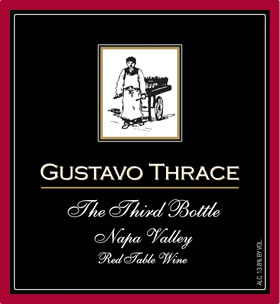
gustabo_red_front_sm.jpg

Imagine a dinner party–maybe… six people… three couples, right? You gotta figure that in the average party there will be at least one person who drinks way more than average and at least one person who drinks way less than average. Say that this is a nice meal… appetizer, main course, dessert. Start off with a white… then move onto a light red, maybe a pinot…

Continue reading

Chillin’ with Albariño in Silver Lake: or, How Getting Lost on the Way to Intelligentsia Coffee Prevented Jonathan From Being Mugged

10 Feb

After a week at LegalZoom, I need a good day of rest and relaxation. “Rest” for me means driving to two different wine shops, while “relaxation” means drinking wine.

I was joined by my college bud Jonathan Lewis, who seems to split his time evenly between Berkeley and Los Angeles. The plan was to visit Silverlake Wine, where I was to pick up four bottles of the Ampelos Rosé of Syrah for myself and some co-workers. I also wanted to visit Intelligentsia Coffee, a Chicago institution that had just recently headed west.

I had some time to kill beforehand, so I decided to take a trip down the 134 to Colorado Wine Company in Los Feliz first. Specifically, I wanted to pick up a bottle of “The Third Bottle” red from GustavoThrace. I paid my $9.99 + tax for the bottle and headed up the 2 to Silver Lake for my rendezvous.

This was the first time I ever visited Silverlake Wine. I was very impressed. The store is large and very well-laid out. The workers there are courteous, funny, and very helpful. There seems to be a steady flow of customers, and many of them have questions about wine pairings that the attendants seem to nail right away. They also have wine tastings, including one I just missed featuring Maynard Keenan, lead singer of Tool and A Perfect Circle. Apparently Maynard is a huge wine buff and has his own vineyard, where he makes his own wine!

bg_sample13.jpg

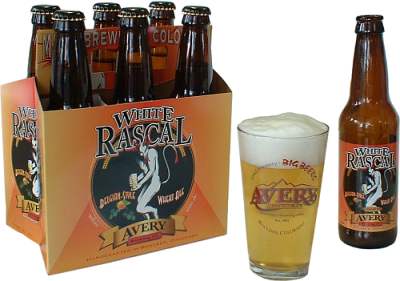
I was a bit early, so while waiting I had a bottle of the White Rascal Belgian white ale from Avery Brewing Company:

image.jpg

It’s fuller than that other famous Belgian white ale, Hoegaarden, but has the same light, refreshing taste punctuated by orange zest and spice. Also, it was only $1.75 a bottle at Silverlake Wine, which makes for some good drinkin’.

Continue reading

Spring in a Glass: 2006 Ampelos Rosé of Syrah

9 Feb

I am not the biggest fan of white wines. Anything lighter than, say, a pinot noir is subject to my intense scrutiny and occasional disdain. Even pinot noirs are not on safe ground: it’s the rare pinot that I like. Beaujolais and beaujolais nouveau are lighter than pinot noir but I like them for some reason–they’re whimsical, easygoing wines.

My first exposure to rosés was when I worked at Adagia Restaurant in Berkeley–specifically, we had Brander Vineyard’s Chateau Neuf de Pink and Domaine Tempier’s Bandol rosé. From what little I remember of those two wines, I liked Tempier–it had an austere quality, bone-dry. All I remember of Brander’s selection is chef Brian Beach poking fun at the name.

All in all, however, I was unimpressed. Reds–especially the brooding malbec and the sensual shiraz–were still my willing mistresses.

That changed when I tasted the Ampelos Rosé of Syrah last year. It was the late summer, hot as heck. “Teeth-staining” and “tannic” were not the qualities I was looking for in my wines, let alone any beverage. At a tasting they poured the Ampelos rosé and it was love at first taste.

Continue reading

The Psychology of a Dying Party, or: The Elements of a Good Party

4 Feb

One of my favorite books is Cannery Row by John Steinbeck.  It’s one of his shorter works, clocking in at only 228 pages as opposed to his masterpieces, The Grapes of Wrath and East of Eden.  It’s also one of his “happier” books–though happier is a subjective term.  It’s happier than East of Eden but not a happy book.  It’s lighthearted at times, but lighthearted in the way only deeply profound insights can seem to be.

The plot doesn’t drive itself as much as it saunters and moseys easily along.  The basic plot is set in the Cannery Row district of Monterey and revolves around a cast of well-meaning bums trying to throw a party for Doc, who is the central figure of the story.  They throw one party that ends in disaster but, by the end of the book, are able to throw a party that is hugely successful.

(What does this have to do with wine?  Or anything, for that matter?  Patience.  Have another sip of your merlot.  I’m getting to it.)

As a former social chair at a fraternity and a catering assistant for almost three and a half years, I’ve seen my share of parties–both highly organized and wildly spontaneous.  I’ve seen seventy-year-olds get drunk off their minds at bar mitzvahs and what looked like seventeen-year-olds do keg stands in dark basements.  There are events complete with wine charms and little signs for different types of cheese, and others that aren’t planned as much as they arise from some primordial, yearning, post-pubescent muck.

What characterizes a good party?  And how can one ensure that the party one is throwing is a success?

Continue reading

Mission Wines Tasting: The (Second) Best Pinot Noir I’ve Ever Had

30 Jan

Yet another tasting at Mission Wines, this time with my co-workers: Erica, who resembles a surly Irishman the more she drinks; Denny, the soft-spoken yet outrageous DJ who somehow lost his way coming back from the restroom to his turntables at some dark club and found himself working in a cubicle on the ground floor of LegalZoom.com; and Katherine, a newbie whose only distinguishing feature to me at the present time is her being Korean. And female. (Kidding, Katherine! You’re not female.)

Manning (Peyton? Eli? Archie or Cooper?) or, if you will, womanning the bar was Debbie, a delightful woman who crossed over years back from Colorado to pursue a love of wine. Heck, I would drive hundreds of miles for wine. In fact, that’s the primary reason I head up to Berkeley so often (sorry Jonathan!). She served us the five wines on the menu, as well as two more “bonus” pours.

The wines were:

J. Hofstatter “De Vite” Pinot Grigio | Alto Adige, Italy | 2005 | $11.99
We took turns writing tasting notes. My notes for this wine were “uber-light.” Kat’s notes were a star surrounded by a circle, along with the word “unfabulous”, which I’m not even sure is a word (thanks, spell check!). This pinot grigio was too light, too insubstantial. It was citrusy, which isn’t a bad thing, but to my palate at least it also seemed to have that plasticine taste I abhor in whites. As Mark Oldman notes in his Guide to Outsmarting Wine, much pinot grigio is “often like experiencing an IKEA rug, Ben Stein’s voice, or a dose of Paxil: neutral, monotone, and devoid of highs.” And watery. The region of Alto Adige is apparently home to some more “interesting versions” of pinot grigio, but this particular bottle was not one of them.

Continue reading

Mmm Mmm, Malbec!

20 Jan

I love malbec. The best are sensual, sexy, full-bodied red wines that, at a price range between $7.99 – $11.99, are a great bargain.

It’s sort of an immigrant grape. One of the up to six grapes used in Bordeaux wines, it rarely took center stage except in other more “rustic” regions like Cahors. (One example is the really excellent Clos La Coutale from Cahors, which is a bit southeast of Bordeaux. The Clos La Coutale is 70% malbec, 15% merlot, and 15% tannat. This Kermit Lynch selection has the finesse and grace of a fine merlot but the suppleness of a Argentine malbec.) It took the importation of this grape to the New World in the mid-1800s to give malbec the home it deserved.

The growing conditions in South America–especially Argentina–were ideal for malbec, which requires more sun and heat than cabernet and merlot (its more famous compatriots). This allows for New World wines that are 100% malbec.

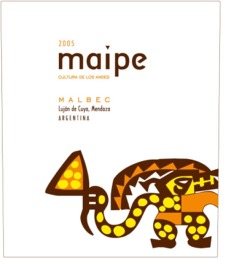
My favorite malbec is from Maipe, which is an intense, staining shade of deep purple. It almost pulses with an animal, sensual energy. There are dusty fruit aromas that, upon drinking, fill your mouth with an utterly satisfying, powerful explosion of plum, chocolate, earth. It’s a bronze fist covered with a silk glove. It is delicious by itself, with chocolate, with anything you can throw at it–I wouldn’t, however, pair it with fish or anything too delicate. The Maipe would destroy any gentle partner.

maipe_malbec.jpg

Continue reading

The Green Day Syndrome of Wine and the Sam Adams of Wine

15 Jan

I have to admit that I am a bit of a wine snob (as if this blog weren’t proof enough!). I go for “artisanal” or quirky wines, or wines from obscure French domaines and Spanish bodegas. When it comes to huge wine conglomerates like Kendall-Jackson, Robert Mondavi, etc., etc., I usually turn up my nose in disdain.

But as Mark Oldman points out in his entertaining, easily-accessible, and informative book Oldman’s Guide to Outsmarting Wine: 108 Ingenious Shortcuts to Navigate the World of Wine with Confidence and Style (link to Amazon here!), there are many low-cost, high-value wines out there from winemakers I felt were “too big” or “too successful”.

Call it the Green Day syndrome of wine.

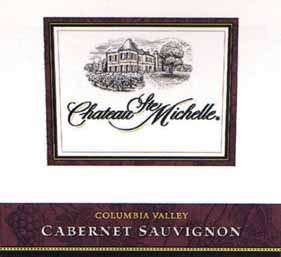
At any rate, one of the producers he mentioned numerous times as consistently satisfying was Chateau Ste. Michelle. Never mind that this winery is in Washington state and has a name like a bad French domaine. It is Washington’s oldest “and most acclaimed” winery, and its labels can be seen in supermarket aisles everywhere:

2001-chateau-ste-michelle.jpg

For “hip” young wine drinkers like me, this ubiquity was a death knell.

Continue reading

Farmer’s Market and Cost Plus Market

9 Jan

So after a hiatus consisting of a few days of unremarkable wine (a bottle of [yellow tail] shiraz seduced me with its fanciful clothing, slender, sleek neck, and cheap price–much to my regret) and long, dreary days at LegalZoom.com, I managed to catch up with my college friend Will Gordon. He was in town, visiting from Berkeley, and we dropped by my perennial favorite–the Farmer’s Market on Fairfax.

Dinner was at the dependable Monsieur Marcel, which has a wonderful ambiance in the evening. A beautiful, dark brunette smiled to me from the wine bar (at least, I thought it was me!), so things were already taking a turn for the better as we were seated.

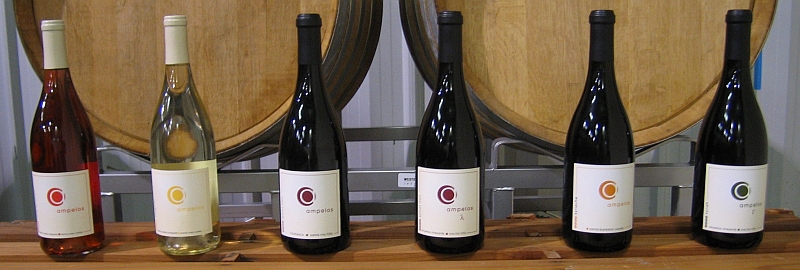
I had a glass of rosé from Chateau de L’Escarelle–in Provence–made from cinsault and grenache. It was wonderful–absolutely breathtakingly fresh, full of ripe strawberry, not in the least bit cloying. It was light but had substantial heft for a rosé. And at $6.49 a glass (one of the less expensive wines on the menu) it was nice to my wallet. This wine reminded me of another wonderful rosé, the Rosé of Syrah from Ampelos Cellars of the Santa Rita Hills in California:

ampelos-bottles.jpg

Will had a glass of the 2004 tempranillo from Bodegas Ercavio. It was fruitier than other tempranillos I’ve had–less vanilla from oak. (Maybe this is because Bodegas Ercavio is not in Rioja, which has a reputation for oakiness.) It was a light, pleasing red, and well-priced at $6.99.

Continue reading

Sparkling Pinot Noir: Mission Wines Tasting

30 Dec

At Mission Wines, my friends and I are the sole representatives of the 25 and under demographic.

It’s a bit sobering to chip in five or ten bucks each for a $20 or $30 bottle of wine–nothing to shake a stick at–and watch as silver-haired gentlemen wearing well-worn L.L. Bean vests and Eddie Bauer sweaters carry out cases (CASES!) of $50 wine to their idling sports cars.

That’s why I love going to wine tastings. For $10 I can try five different wines. Nothing’s worse than spending good money on a vaunted bottle of wine and finding that it’s terrible. (I guess the same goes for first dates, eh?)

The five wines at the tasting today were:

  • Juve y Camps Brut Rosé | Sparkling Pinot Noir (Sant Sadurini D’Anoia, Spain)
  • Breggo Ferrington Vineyard | Sauvignon Blanc (Anderson Valley, California)
  • Luzon | Monastrel/Syrah (Jumilla, Spain)
  • Chateau Puygueraud Cotes de Francs | Merlot/Cabernet Franc/Malbec (Bordeaux, France)
  • Graves | Syrah (Paso Robles, California)

Continue reading

2001 L’esprit du Silene

27 Dec

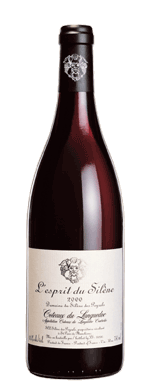
This is a wine that is very near and dear to my heart.  This is one of the first bottles of wine that I drank and actually paid attention to.

Alex and I split the cost of the bottle, which in retrospect seems ridiculous as it retails for $10.99.  No matter: at that time we were of the impression that $5 was too much for a bottle, much less $11!

esprit_rouge.gif

This wine is from Domaine du Silène des Peyrals in the Languedoc region of France, specifically the Coteaux du Languedoc appellation.  The Languedoc might be new to people (especially relative to its more famous cousins, Bordeaux, Burgundy, and Champagne) but it accounts for more than a third of France’s total wine production. 

Continue reading