Spring in a Glass: 2006 Ampelos Rosé of Syrah

9 Feb

I am not the biggest fan of white wines. Anything lighter than, say, a pinot noir is subject to my intense scrutiny and occasional disdain. Even pinot noirs are not on safe ground: it’s the rare pinot that I like. Beaujolais and beaujolais nouveau are lighter than pinot noir but I like them for some reason–they’re whimsical, easygoing wines.

My first exposure to rosés was when I worked at Adagia Restaurant in Berkeley–specifically, we had Brander Vineyard’s Chateau Neuf de Pink and Domaine Tempier’s Bandol rosé. From what little I remember of those two wines, I liked Tempier–it had an austere quality, bone-dry. All I remember of Brander’s selection is chef Brian Beach poking fun at the name.

All in all, however, I was unimpressed. Reds–especially the brooding malbec and the sensual shiraz–were still my willing mistresses.

That changed when I tasted the Ampelos Rosé of Syrah last year. It was the late summer, hot as heck. “Teeth-staining” and “tannic” were not the qualities I was looking for in my wines, let alone any beverage. At a tasting they poured the Ampelos rosé and it was love at first taste.

Continue reading

The Psychology of a Dying Party, or: The Elements of a Good Party

4 Feb

One of my favorite books is Cannery Row by John Steinbeck.  It’s one of his shorter works, clocking in at only 228 pages as opposed to his masterpieces, The Grapes of Wrath and East of Eden.  It’s also one of his “happier” books–though happier is a subjective term.  It’s happier than East of Eden but not a happy book.  It’s lighthearted at times, but lighthearted in the way only deeply profound insights can seem to be.

The plot doesn’t drive itself as much as it saunters and moseys easily along.  The basic plot is set in the Cannery Row district of Monterey and revolves around a cast of well-meaning bums trying to throw a party for Doc, who is the central figure of the story.  They throw one party that ends in disaster but, by the end of the book, are able to throw a party that is hugely successful.

(What does this have to do with wine?  Or anything, for that matter?  Patience.  Have another sip of your merlot.  I’m getting to it.)

As a former social chair at a fraternity and a catering assistant for almost three and a half years, I’ve seen my share of parties–both highly organized and wildly spontaneous.  I’ve seen seventy-year-olds get drunk off their minds at bar mitzvahs and what looked like seventeen-year-olds do keg stands in dark basements.  There are events complete with wine charms and little signs for different types of cheese, and others that aren’t planned as much as they arise from some primordial, yearning, post-pubescent muck.

What characterizes a good party?  And how can one ensure that the party one is throwing is a success?

Continue reading

Nuevo Tango

2 Feb

I just came home from another tasting at Mission Wines. I love that place–most of all because it’s like five minutes from where I live.

So it stands to reason that I’ve had a bit to drink–actually, a lot to drink. But the alcohol has been somewhat counteracted by two soft tacos and a carne asada burrito, courtesy of the taco truck on the corner of Fair Oaks and Bellevue.

I’m at home right now, comfortably numb and full of good, hearty Mexican food. I’m listening to some nuevo tango: Pablo Ziegler & Quique Senesi. Pablo Ziegler apparently is the heir of Astor Piazzolla, that master of the bandoneón (a relative of the accordion that is especially popular in the tango music of Argentina) who originated nuevo tango, or new tango.

Nuevo tango is characterized by non-traditional elements, especially those of classical and jazz, incorporated into traditional Argentine tango. It is apparently derided by purists, but Astor Piazzolla and nuevo tango are a big reason why tango is as popular as it is outside of the Latin world.

I have a suggestion. Download “Adiós Nonino” off of the Live Lugano 13 Ottobre 1983, or Adiós Nonino album. Download “Escualo” and “Libertango” off the same album (the latter is one of Pizzaolla’s most popular pieces). Then, download “Milonga del Angel” off of Tango: Zero Hour. After you have been introduced to those singles, listen to “Los Mareados” by Pablo Ziegler.

And, if you can, listen to these with the lights off, a candle or two burning, some deep, dark malbec from Mendoza straining against its glass enclosure. Close your eyes. Smell the amber scent of her skin as she puts her cool hands over your eyes, and sink into the sensation of the bandoneón dueling with the violin for your heart against the throbbing pulse of the double bass.

Mission Wines Tasting: The (Second) Best Pinot Noir I’ve Ever Had

30 Jan

Yet another tasting at Mission Wines, this time with my co-workers: Erica, who resembles a surly Irishman the more she drinks; Denny, the soft-spoken yet outrageous DJ who somehow lost his way coming back from the restroom to his turntables at some dark club and found himself working in a cubicle on the ground floor of LegalZoom.com; and Katherine, a newbie whose only distinguishing feature to me at the present time is her being Korean. And female. (Kidding, Katherine! You’re not female.)

Manning (Peyton? Eli? Archie or Cooper?) or, if you will, womanning the bar was Debbie, a delightful woman who crossed over years back from Colorado to pursue a love of wine. Heck, I would drive hundreds of miles for wine. In fact, that’s the primary reason I head up to Berkeley so often (sorry Jonathan!). She served us the five wines on the menu, as well as two more “bonus” pours.

The wines were:

J. Hofstatter “De Vite” Pinot Grigio | Alto Adige, Italy | 2005 | $11.99
We took turns writing tasting notes. My notes for this wine were “uber-light.” Kat’s notes were a star surrounded by a circle, along with the word “unfabulous”, which I’m not even sure is a word (thanks, spell check!). This pinot grigio was too light, too insubstantial. It was citrusy, which isn’t a bad thing, but to my palate at least it also seemed to have that plasticine taste I abhor in whites. As Mark Oldman notes in his Guide to Outsmarting Wine, much pinot grigio is “often like experiencing an IKEA rug, Ben Stein’s voice, or a dose of Paxil: neutral, monotone, and devoid of highs.” And watery. The region of Alto Adige is apparently home to some more “interesting versions” of pinot grigio, but this particular bottle was not one of them.

Continue reading

Mmm Mmm, Malbec!

20 Jan

I love malbec. The best are sensual, sexy, full-bodied red wines that, at a price range between $7.99 – $11.99, are a great bargain.

It’s sort of an immigrant grape. One of the up to six grapes used in Bordeaux wines, it rarely took center stage except in other more “rustic” regions like Cahors. (One example is the really excellent Clos La Coutale from Cahors, which is a bit southeast of Bordeaux. The Clos La Coutale is 70% malbec, 15% merlot, and 15% tannat. This Kermit Lynch selection has the finesse and grace of a fine merlot but the suppleness of a Argentine malbec.) It took the importation of this grape to the New World in the mid-1800s to give malbec the home it deserved.

The growing conditions in South America–especially Argentina–were ideal for malbec, which requires more sun and heat than cabernet and merlot (its more famous compatriots). This allows for New World wines that are 100% malbec.

My favorite malbec is from Maipe, which is an intense, staining shade of deep purple. It almost pulses with an animal, sensual energy. There are dusty fruit aromas that, upon drinking, fill your mouth with an utterly satisfying, powerful explosion of plum, chocolate, earth. It’s a bronze fist covered with a silk glove. It is delicious by itself, with chocolate, with anything you can throw at it–I wouldn’t, however, pair it with fish or anything too delicate. The Maipe would destroy any gentle partner.

maipe_malbec.jpg

Continue reading

Wine Snobbery

20 Jan

It’s easy to poke fun at people like Miles in the movie Sideways (which was better as a movie than the book was as a book, in my opinion)–people for whom the entire world revolves around wine.  It’s also fun to stand around in some fancy wine bar and agree with your friends that adjectives like gunflint, slate, leather, barnyard, plum, stone fruit, etc., etc., etc. are just the sign of snobbishness.

But in reality, isn’t that what much of the fun of wine is all about?

Sitting around a table at night with one of two of your friends, a bottle or two of newly-purchased wine.  The first is–say, the 2006 estate riesling from Robert Eymael, which is a gorgeous amber or straw color, sweet, with a honeyed mouthfeel.  It’s nice to take turns describing the wine in terms wine critics would be proud of, nice to know that for a little bit of money one can feel part of the social and cultural elite.

Because that’s a huge reason for why someone would start to have an interest in wine.  People who choose to take an active interest in anything–poetry, sports, cars, food, photography, music–start to delve deeper into their subject, to examine all the details and nuances of the Red Sox or William Carlos Williams (one point for someone who can name the very superficial link between those two!).

Yet wine transcends mere hobby.  It’s a lifestyle–more than that, it’s a statement of a lifestyle.  It’s very possible to drink wine casually with dinner or during social gatherings.  But why not… water… or soda…?  Or malt liquor, for that matter? 

To get a nice buzz is a good reason.  But come on.  Anyone who’s ever tried to impress a date would know that a glass of good wine is more showy than a glass of Mr. Pibb (which is delicious).  A glass of wine says something.  A glass of soda does not.

There is the 100-point scale of Robert Parker.  There is the “Do You Know What You Like?” metric developed by Best Cellars (try it–it’s great!).  There is the rather unorthodox method of Wine X Magazine of comparing wines to songs, or ideas like “a deep French kiss in a phone booth–nice depth, great mouth feel, a little woody, a bit tight.”  Then there is the Song family method of “good” and “bad” wine.

There are so many wines out there, so many different regions and winemakers and varietals and cuvees and blends–it’s impossible to learn about wine without relying on categorizations.  So have fun–feel classy–write tasting notes–get a little bit snobby.  Give wines a score, assign them an idea, or split them into the good and the bad.  It’s why you picked up that bottle before showing up to a fancy dinner party, right?

UPDATE: My friend Laszlo just as I published this post sent me this link for an article from The Wall Street Journal that talks about wine snobbery!  Give it a read!

The Green Day Syndrome of Wine and the Sam Adams of Wine

15 Jan

I have to admit that I am a bit of a wine snob (as if this blog weren’t proof enough!). I go for “artisanal” or quirky wines, or wines from obscure French domaines and Spanish bodegas. When it comes to huge wine conglomerates like Kendall-Jackson, Robert Mondavi, etc., etc., I usually turn up my nose in disdain.

But as Mark Oldman points out in his entertaining, easily-accessible, and informative book Oldman’s Guide to Outsmarting Wine: 108 Ingenious Shortcuts to Navigate the World of Wine with Confidence and Style (link to Amazon here!), there are many low-cost, high-value wines out there from winemakers I felt were “too big” or “too successful”.

Call it the Green Day syndrome of wine.

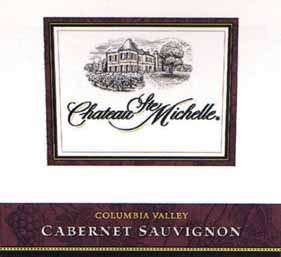
At any rate, one of the producers he mentioned numerous times as consistently satisfying was Chateau Ste. Michelle. Never mind that this winery is in Washington state and has a name like a bad French domaine. It is Washington’s oldest “and most acclaimed” winery, and its labels can be seen in supermarket aisles everywhere:

2001-chateau-ste-michelle.jpg

For “hip” young wine drinkers like me, this ubiquity was a death knell.

Continue reading

Farmer’s Market and Cost Plus Market

9 Jan

So after a hiatus consisting of a few days of unremarkable wine (a bottle of [yellow tail] shiraz seduced me with its fanciful clothing, slender, sleek neck, and cheap price–much to my regret) and long, dreary days at LegalZoom.com, I managed to catch up with my college friend Will Gordon. He was in town, visiting from Berkeley, and we dropped by my perennial favorite–the Farmer’s Market on Fairfax.

Dinner was at the dependable Monsieur Marcel, which has a wonderful ambiance in the evening. A beautiful, dark brunette smiled to me from the wine bar (at least, I thought it was me!), so things were already taking a turn for the better as we were seated.

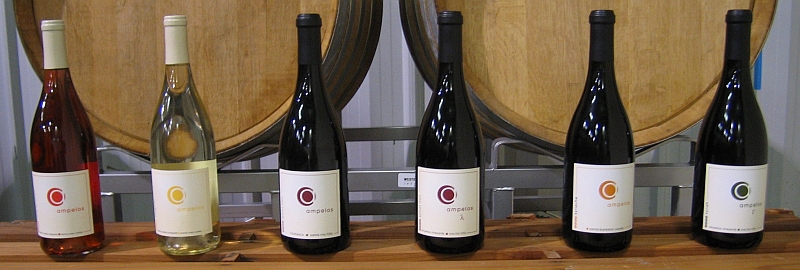
I had a glass of rosé from Chateau de L’Escarelle–in Provence–made from cinsault and grenache. It was wonderful–absolutely breathtakingly fresh, full of ripe strawberry, not in the least bit cloying. It was light but had substantial heft for a rosé. And at $6.49 a glass (one of the less expensive wines on the menu) it was nice to my wallet. This wine reminded me of another wonderful rosé, the Rosé of Syrah from Ampelos Cellars of the Santa Rita Hills in California:

ampelos-bottles.jpg

Will had a glass of the 2004 tempranillo from Bodegas Ercavio. It was fruitier than other tempranillos I’ve had–less vanilla from oak. (Maybe this is because Bodegas Ercavio is not in Rioja, which has a reputation for oakiness.) It was a light, pleasing red, and well-priced at $6.99.

Continue reading

The End of Smoking in France?

2 Jan

This post has almost nothing to do with wine, except that cigarettes often go well with wine (as with many other things: coffee, World War II, seedy hotels, the 1940s, Russia, women).

And I admit that the title of this post is a bit extreme. To my defense, I just recently finished an excellent biography of Theodore Roosevelt, wherein the Spanish-American War (“Cuba Libre!”) broke out and the yellow press stirred up jingoism that knew no bounds. My writing, therefore, will probably be more sensationalist than usual.

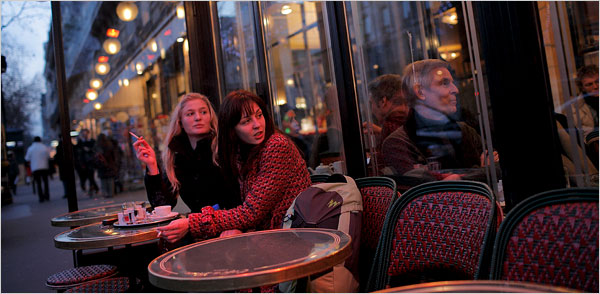
That being said, the New York Times reported a smoking ban that went into effect on Wednesday in France. According to the article, “smoking has been banned in every commercial corner of ‘entertainment and conviviality’ — from the toniest Parisian nightclub to the humblest village cafe.”

french-women-smoking.jpg

I can see why this had to happen. The article cited statistics where more than 70,000 Frenchmen/women/babies die from smoke- and second-hand smoke-related illness every year. If Amélie were to have worked in that little Parisian café for the rest of her life, chances are she would have died of emphysema at 65.

Continue reading

Keeping the Skies Safe from Exploding… Bottles of Wine?

1 Jan

(My thanks, first, to Joe for forwarding this article to me.)

I remember the days when I was able to wait for my brother, flying in from college in New York, right at the gate. Going to the airport sucks in general, but this fact was in part ameliorated by being able to kill time at the magazine rack, McDonald’s, or Starbucks. And, of course, there’s no substitute for the gratification of seeing a loved one after months of separation.

And then September 11th. Homeland Security. The Transportation Security Administration. Suddenly, you couldn’t wait at the gate. You had to stand with the other schmucks at baggage claim.

But that wasn’t nearly as bad as when, maybe less than two years ago, the TSA instituted the 3-1-1 Rule.

311_header.jpg Continue reading