Archive | tasting notes RSS feed for this section

A Joyful Wine: 2007 Côtes du Rhône “Cuvée Sélectionée par Kermit Lynch”

4 Feb

My joy is complete.

I just found a bus line–the D6–that takes me from 20th and L Street to MacArthur and V Street.  What’s at MacArthur and V Street?  Only one of the finest wine shops in the DC Metro area: Addy Bassin’s MacArthur Beverages.

You might recall an earlier post where I purchased the bottles for a Spanish wine tasting from MacArthur.  My mission today was to pick up a bottle of the 2001 Penfolds “RWT” Barossa Valley Shiraz for a fancy Australian Shiraz tasting I’m having next week.  However, I ended up, as per usual, lingering for a bit, talking with Phil (an excellent wine steward who remembered that the last time I came in–last semester–I was wearing a suit and had picked up a bottle of the 1999 R. Lopez de Heredia “Viña Gravonia” blanco), and picking up a whole lot more than I came in for.

I was in the mood to pick up nice, simple table wines–nothing too pricey but still offering good quality to price.  Something like the 2008 Vin de Pays du Vaucluse from Domaine de Durban, an $8.99 table red made mostly of Grenache from Kermit Lynch that was just so fun and delicious to drink.

Bingo.
Continue reading

The Great Ridge Zinfandel Line-Up: Or, Yet Another Reason Why California is the Best State

4 Feb

One of my favorite pastimes in DC is to discuss ways in which California is superior to every other state.  This usually takes place in the company of fellow Californians, as people who aren’t from Cali simply can’t comprehend how their domiciles are inferior.

All kidding aside, California does have a lot going for it.  This being a wine blog, I will restrict the discussion of California’s awesomeness to wine.  Of course, there’s Napa.  Sonoma.  Paso Robles.  There’s Cabernet.  There’s Pinot.  There’s Chardonnay.  Etc., etc., etc.

But just as overexposure to sun can lead to premature wrinkles and skin cancer, and being in the shadow of Hollywood creates self-aggrandizers, posers, and shallow B-list types, so can the sun lead to huge, overly-ripe wines, and so can being in the shadow of Napa create wines that, in undergoing sugar Botox and oak augmentation, have become caricatures.

Thus, there are so many California Cabs that are as undrinkably oaky, and California Chards that leave nothing to the imagination.  Hence my migration towards the refined, subtle graces of Burgundies.

Thank God for Zinfandels.

Continue reading

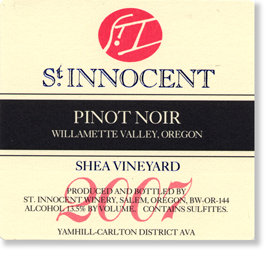
2007 St. Innocent “Shea Vineyard” Pinot Noir: A Great Breakfast Wine

24 Jan

Is it obsessive to, when you are taking a bottle of wine over to a friend’s place, also want to bring a decanter and proper stemware?

Come on, you wouldn’t put regular unleaded in a sports car, right?  Yes, yes, I know that that analogy is flawed, but you get the idea.

Such was the question that plagued me when I was bringing over a bottle of the 2007 St. Innocent “Shea Vineyard” Pinot Noir (from the Willamette Valley, Oregon) ($49.00 at Bell Liquor & Wine Shoppe) for a movie night with a friend.  I asked my roommate whether bringing the decanter and some Burgundy glasses would be too much.

“Um… yeah,” he replied, looking at me like I was crazy.  (Then again, this is the guy who recently ran a 50-mile marathon.)  So I decided not to bring the decanter and the wine glasses, even though the Pinot was almost criminally young.  It was with some trepidation, therefore, that I opened the bottle and poured some into wine glasses the hostess provided.

Continue reading

California and Californian Wines: the 2007 “Geyserville” and “Lytton Springs” from Ridge

7 Jan

I am writing this post from my plain wooden desk here in DC.  It’s freakin’ cold here, and drafts blow in from the assuredly-closed plate-glass windows to my left, turning my poor feet into blocks of ice.  I’ve been in DC only since around 9 pm on Sunday, and already the healing properties of sunny SoCal rise again as memory in my mind.

I was fortunate enough to have spent the past two and a half weeks in Los Angeles with my family and my sister’s Chihuahua, Twinkie:

Aside from food from Lucky Boy, Taco Bell and various Mexican restaurants of varying degrees of authenticity, endless Chinese, and some delicious, delicious omakase-style sushi at Sushi Sasabune courtesy of my brother, I drank a fair amount of wine (though not as much as I had hoped to).  Of particular note was a bottle of champagne I purchased for New Year’s with my family, a delightful Louis Roederer brut that went well with Peking duck.

Continue reading

Burgundy: Not Just for the Reds

12 Dec

About a week or so ago I wrote a post about some delicious, delicious red Burgundies I shared with some staffers of the Nota Bene.  However, that was only half the story, as along with the three excellent pinots we tried three chardonnays.

I think a lot of people, when they think about Burgundy, see in their mind’s eye big jug wines labeled “Burgundy.”  (An aside: I was looking up Carlo Rossi’s Burgundy to see what grapes go in it but was unsuccessful.  I have no clue what goes in their Burgundy, and apparently no one on the Internet cares enough to do the research!)  This is horrible, and my hat goes off to those wine drinkers who appreciate well-crafted, artisanal pinot noir-based Burgundies from Burgundy, France.

But that’s not all this wondrous region has to offer.  I would argue that some of the world’s greatest white wines–and definitely the world’s greatest chardonnays–come from Burgundy.  Those white Burgundies I’ve tried have all been vastly superior–to my palate, at least–to those super-oaky butterballs that California seems to churn out with a vengeance.

To each his own, though, right?  This might be the case, but in my age demographic (20-30, generally) white Burgundies get ignored.  This can be chalked (heh) up to four broad reasons:

  1. When people think of Burgundy, they think of horrible jug wines.
  2. When people don’t think of Burgundy in terms of jug wines, they think that all Burgundies are red.
  3. Many people are turned off by the “butterball” super-oaky style of chardonnay championed by Californian winemakers.
  4. White Burgundies can be friggin’ expensive.

I’ve already addressed numbers one and two.  As regards number three, white Burgundies are as a general rule much less oaky than California wines.  However, they do exist on a stylistic scale ranging from lean and mean to round and supple, which makes Burgundy a veritable playground of chardonnay.

Continue reading

A Burgundy Moment

4 Dec

I’ve been meaning to update this blog with the results of a fantastic Burgundy tasting I hosted for the staff of the Nota Bene a few weeks ago, but I never got around to it (I think finals, which start next week, has something to do with it).  However, a post on the Kermit Lynch Wine Merchant blog “Inspiring Thirst” inspired me to post at least a short entry on a few of the wines we drank that evening.

We had a spate of seven wines for the tasting, starting with the decidedly NOT Burgundian Drappier “Carte d’Or” Blanc de Blancs Brut Champagne which I included because, hell, it’s 100% chardonnay, and hell, who doesn’t like Champagne?  We went through three whites–a basic Mâcon-Villages, a Chablis, and a Chassagne-Montrachet–and three reds.

The first red, the 2005 Domaine René Leclerc Bourgogne, was a basic rouge I picked up at MacArthur Beverages for around $25.  However, it was really, really good, with nice acidity, some spice, and a hint of funk.  This is definitely something I’d pick up as a “house Burgundy” if I ever make that much money in the future.

Continue reading

Even Dwarves Started Small: Alex’s Ultramarathon, a 1990 Riesling, and Herzog’s New Movie “Bad Lieutenant”

24 Nov

As I had mentioned in my previous post, my roommate Alex ran the JFK 50 Miler on Saturday, finishing 41st out of 1050 competitors.  As per our custom, to celebrate and to help him recuperate I cook a “fancy” protein-filled dinner for him a day or two afterwards.

This particular meal, however, would be extra-special.

I had purchased a case of wine from the excellent MacArthur Beverages in Georgetown a few months ago, ostensibly for the purpose of hosting various wine tastings (including the Spanish tasting, the notes from which you can read here, and the outstanding Burgundy tasting, the write-up of which will be coming out later this week).  While there I came across this bottle:

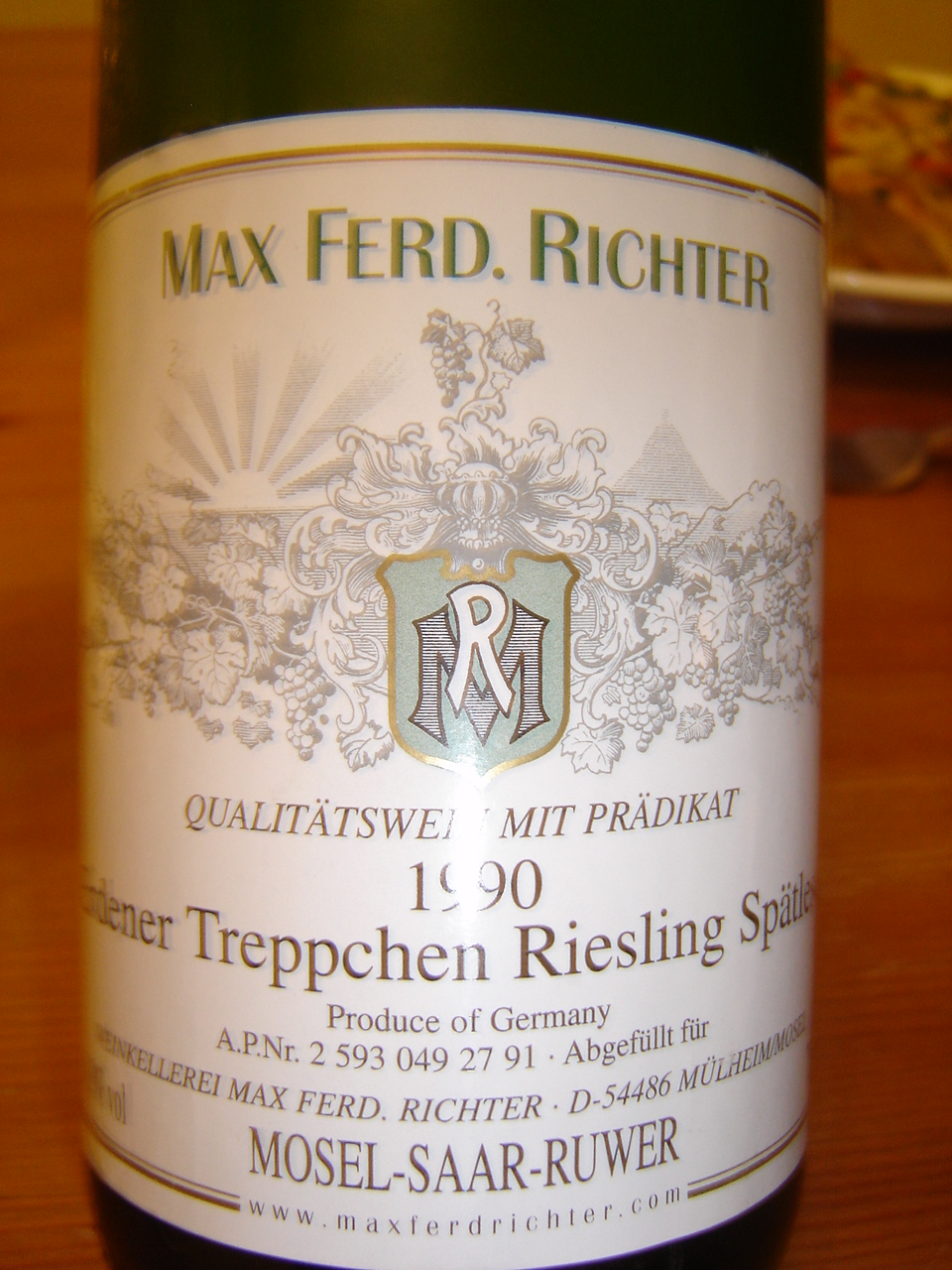
It was the 1990 Weingut Max Ferd. Richter Erdener Treppchen Riesling Spätlese from the Mosel region of Germany (seen on the label as Mosel-Saar-Ruwer).

I was intrigued.  Law students don’t come across 19-year-old bottles of wine very often; one comes across old white wines even less frequently.  The price was right, too, at around $35-$40.  Phil, one of the wine stewards, saw that I was getting a few off-the-beaten-path-type wines like the 1999 Viña Gravonia Crianza and recommended the wine, saying that it was still very much alive and well though with some of the characteristic oxidation found in aged whites.  To seal the deal, the wine was apparently stored at the winery in perfect conditions until only a few months prior.  I couldn’t resist.

After the Burgundy tasting a few weeks ago, this was the last wine from my memorable trip to MacArthur Beverages.  But it was soon to join its noble brethren, as I had plans to open it for Alex’s celebratory meal.

For dinner, we invited the always engaging (and fellow Golden Bear) Waiching, who brought fresh blueberries and blackberries for dessert.  I can’t really describe what I cooked–it’s a recipe I made up some time ago and never bothered to write down.  I guess it could loosely be named lemon-mushroom chicken.  For my own purposes (I forgot what ingredients I needed while I was shopping for the meal at Trader Joe’s) I will list the recipe here:

Continue reading

Swine Make Good BBQ (but Bad Wine): Travels with James and Nick in Search of America’s Finest BBQ

27 Oct

There is something therapeutic about seeing trees and towns and wide blue sky passing by you at 80 miles per hour as you sit in a car, listening to good music, on your way to somewhere.  It is an added bonus when those trees are at that moment when they are still lush but where the leaves are no longer green but various hues of yellow, red, brown, and orange.

Such were the trees on the road on the way to Lexington, North Carolina, whose Barbecue Festival my friend James (of The Eaten Path fame), our friend Nick (of the US Patent and Trademark Office) and I attended this past weekend.

bbq26_hmpg

(Thank you to the Lexington BBQ Festival for this poster!)

For those of you who do not know of James by this point, he is one of my good friends from Berkeley who has for the last year called Brooklyn, New York home.  While his more regular contributions to the blogosphere can be seen on The Eaten Path, he also is a huge aficionado of all things barbecued, once spending a few weeks traveling through the Smoky Crescent and eating and observing the best the South had to offer.  It is one of his goals to publish a comprehensive and awesome book on barbecue–a noble goal, indeed.

Thus, when he said there was a barbecue festival in North Carolina I asked if I could go.  I figured I wouldn’t have very many more chances to have a purpose to go to North Carolina, and besides, any reason to get out of DC is reason enough.

Continue reading

Learning to Budget: or, Finding a Nice $8.99 Bottle of Wine

18 Oct

One of the perks of having a German (ahem, Bavarian) roommate is that he’s quite knowledgeable about beer.  I’m more of a wino myself, so I’m only too happy to defer to his judgment, always excellent, on German beers.  (Then again, I can’t not defer, lest I want stormtroopers to take over my living room.)

That being said, Alex the Roommate decided we should have an Oktoberfeast™ where we would feature delicious German foods, beers, and spirits.  Our Berkeley friend Waiching was gracious enough to provide her apartment (and her large dinner table and large number of chairs) for the feast.  Alex invited two friends from his work and I invited one of my Berkeley friends, Mia, and her boyfriend.  That made for a small but wonderful dinner party of seven.

This isn’t an entry about Oktoberfeast™, however; I did want to mention that Alex outdid himself by making from scratch traditional German fare such as Blaukraut (“blue cabbage”, which is made from red cabbage, red onion, raisins, and apple and seasoned with things like nutmeg and bay leaves) and putting together a three-course beer menu, the highlight of which were incredibly potent “smoke beers” from Schlenkerla.  The first variety was their Märzen, a “dark, bottom fermented smokebeer, brewed with . . . Smokemalt”; the second, which I had, was an even more intense Urbock, “[s]imilar to, but much bigger than the classic [Märzen] style.”  The Märzen smelled of smoked gouda, declared Waiching, but my Urbock smelled of a richly-smoked cut of bacon.  They were very unusual but very delicious and well-crafted.  We followed up the beers with some William Christ Pear Brandy, an intoxicating spirit straight from Germany.  Utterly redolent of pear on the nose, it had a hint of sweetness and coated the mouth wonderfully.  It had a slow, steady burn deep in the stomach and helped me digest my huge, huge meal.

Continue reading

R. López de Heredia: Ready When You Are

13 Oct

I write a wine column for my law school newspaper.  Unfortunately, they only pay me $10 per column, which will hardly pay for a bottle of good Portuguese Douro.  I will say that there are a number of great wines out there in the $10-$15 range, but there are a HUGE number of even better wines at the $15+ range.

Short of taking out more in loans, a grad student has few options for financing an education in wine.  Luckily, one of those options is hosting wine tastings where everyone chips in for some really great bottles.

So, I’ve hosted a few tastings for friends and for fellow staffers at the Nota Bene, and we’ve been able to try some delicious, delicious wines (and cheese… and patê…).  The first was themed “Summer Reds” and featured lighter reds (such as Beaujolais and Pinot, including a pretty wonderful pinot–the 2006 Radio-Coteau “Savoy” from the Anderson Valley of California).  The second was themed “Spanish Wines”, which is the topic of this particular blog post, and the third will be based around both red and white Burgundies.

We tasted a number of great Spanish wines: three whites and four reds.  The four reds were further subdivided into two groups: two bottles from Rioja, and two from Ribera del Duero.  One in each pair was “Old World”-style (generally aged longer before being released, less assertive oak, leaner) and the other was “New World”-style (released after a fewer number of years, more assertive oak, bigger and fuller profiles).

Continue reading