The Great Ridge Zinfandel Line-Up: Or, Yet Another Reason Why California is the Best State

4 Feb

One of my favorite pastimes in DC is to discuss ways in which California is superior to every other state.  This usually takes place in the company of fellow Californians, as people who aren’t from Cali simply can’t comprehend how their domiciles are inferior.

All kidding aside, California does have a lot going for it.  This being a wine blog, I will restrict the discussion of California’s awesomeness to wine.  Of course, there’s Napa.  Sonoma.  Paso Robles.  There’s Cabernet.  There’s Pinot.  There’s Chardonnay.  Etc., etc., etc.

But just as overexposure to sun can lead to premature wrinkles and skin cancer, and being in the shadow of Hollywood creates self-aggrandizers, posers, and shallow B-list types, so can the sun lead to huge, overly-ripe wines, and so can being in the shadow of Napa create wines that, in undergoing sugar Botox and oak augmentation, have become caricatures.

Thus, there are so many California Cabs that are as undrinkably oaky, and California Chards that leave nothing to the imagination.  Hence my migration towards the refined, subtle graces of Burgundies.

Thank God for Zinfandels.
Continue reading

100th Post on Vinicultured!

1 Feb

There are many different reasons for why one does anything, reasons that may be small and large, significant and trivial, obvious and perhaps unknowable even to oneself.  Certainly, there are many reasons one decides to write a wine blog.  Learning how to budget was not one of them, but there were things like wanting to learn more about wine, wanting to practice how to write, and wanting to become part of a community.  I loved drinking wine; I loved talking about it, and I loved the culture and ceremony around this most noble of beverages.

But of course, there are still other reasons.

My first post is dated December 23, 2007.  2007 was a very tough year for me and innumerable others.  We lost a wonderful friend that June, and this world lost out on an incredibly talented, beautiful, and giving young woman.

Continue reading

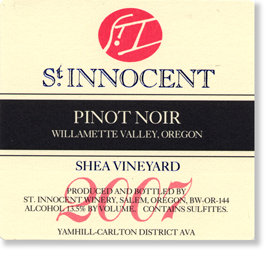
2007 St. Innocent “Shea Vineyard” Pinot Noir: A Great Breakfast Wine

24 Jan

Is it obsessive to, when you are taking a bottle of wine over to a friend’s place, also want to bring a decanter and proper stemware?

Come on, you wouldn’t put regular unleaded in a sports car, right?  Yes, yes, I know that that analogy is flawed, but you get the idea.

Such was the question that plagued me when I was bringing over a bottle of the 2007 St. Innocent “Shea Vineyard” Pinot Noir (from the Willamette Valley, Oregon) ($49.00 at Bell Liquor & Wine Shoppe) for a movie night with a friend.  I asked my roommate whether bringing the decanter and some Burgundy glasses would be too much.

“Um… yeah,” he replied, looking at me like I was crazy.  (Then again, this is the guy who recently ran a 50-mile marathon.)  So I decided not to bring the decanter and the wine glasses, even though the Pinot was almost criminally young.  It was with some trepidation, therefore, that I opened the bottle and poured some into wine glasses the hostess provided.

Continue reading

California and Californian Wines: the 2007 “Geyserville” and “Lytton Springs” from Ridge

7 Jan

I am writing this post from my plain wooden desk here in DC.  It’s freakin’ cold here, and drafts blow in from the assuredly-closed plate-glass windows to my left, turning my poor feet into blocks of ice.  I’ve been in DC only since around 9 pm on Sunday, and already the healing properties of sunny SoCal rise again as memory in my mind.

I was fortunate enough to have spent the past two and a half weeks in Los Angeles with my family and my sister’s Chihuahua, Twinkie:

Aside from food from Lucky Boy, Taco Bell and various Mexican restaurants of varying degrees of authenticity, endless Chinese, and some delicious, delicious omakase-style sushi at Sushi Sasabune courtesy of my brother, I drank a fair amount of wine (though not as much as I had hoped to).  Of particular note was a bottle of champagne I purchased for New Year’s with my family, a delightful Louis Roederer brut that went well with Peking duck.

Continue reading

Burgundy: Not Just for the Reds

12 Dec

About a week or so ago I wrote a post about some delicious, delicious red Burgundies I shared with some staffers of the Nota Bene.  However, that was only half the story, as along with the three excellent pinots we tried three chardonnays.

I think a lot of people, when they think about Burgundy, see in their mind’s eye big jug wines labeled “Burgundy.”  (An aside: I was looking up Carlo Rossi’s Burgundy to see what grapes go in it but was unsuccessful.  I have no clue what goes in their Burgundy, and apparently no one on the Internet cares enough to do the research!)  This is horrible, and my hat goes off to those wine drinkers who appreciate well-crafted, artisanal pinot noir-based Burgundies from Burgundy, France.

But that’s not all this wondrous region has to offer.  I would argue that some of the world’s greatest white wines–and definitely the world’s greatest chardonnays–come from Burgundy.  Those white Burgundies I’ve tried have all been vastly superior–to my palate, at least–to those super-oaky butterballs that California seems to churn out with a vengeance.

To each his own, though, right?  This might be the case, but in my age demographic (20-30, generally) white Burgundies get ignored.  This can be chalked (heh) up to four broad reasons:

  1. When people think of Burgundy, they think of horrible jug wines.
  2. When people don’t think of Burgundy in terms of jug wines, they think that all Burgundies are red.
  3. Many people are turned off by the “butterball” super-oaky style of chardonnay championed by Californian winemakers.
  4. White Burgundies can be friggin’ expensive.

I’ve already addressed numbers one and two.  As regards number three, white Burgundies are as a general rule much less oaky than California wines.  However, they do exist on a stylistic scale ranging from lean and mean to round and supple, which makes Burgundy a veritable playground of chardonnay.

Continue reading

An Exposition on Riedel Glasses

11 Dec
I. Introduction
If you’re reading this blog you’ve probably seen or at least heard of the movie Sideways, which chronicles the last hurrah journey of two friends through the Santa Ynez Valley.  It is filled with fine wine, boozing, women, and other misadventures.  One of the sadder scenes is when Miles, the protagonist, drinks a bottle of his prized ’61 Cheval Blanc alone with a foam fast-food restaurant cup.

Having been in a fraternity, I’ve imbibed from many different sorts of containers: mugs, plastic cups, boxes, the bosom of life.  At the time, I was proud of my set of four Crate and Barrel wineglasses (price: $3.99 each), into which I’d pour only the finest Yellowtail Shiraz and Merlot.

What a difference a few years make.

II. Riedel glassware is awesome.

Drink wine long enough and you’ll eventually come across mention of Riedel stemware.  Riedel has been in the business of glassmaking for eleven generations, so they’ve not only had time to perfect what they’re doing, they’ve had the time to come up with a whole host of awesome crystal products.

Drinking out of a Riedel glass elevates the wine experience for at least two reasons.  First: they’re simply beautiful and well-designed glasses, period.  Most of their lines—including the affordable machine-made Vinum series—are made of lead crystal, which classes up any drinking situation.  They’re well-weighted and feel good in the hand.  Their lips are thin, which avoids the problem some glasses have where it feels like you’re drinking wine from a coffee mug.  And, they are simple and elegant.

Continue reading

A Burgundy Moment

4 Dec

I’ve been meaning to update this blog with the results of a fantastic Burgundy tasting I hosted for the staff of the Nota Bene a few weeks ago, but I never got around to it (I think finals, which start next week, has something to do with it).  However, a post on the Kermit Lynch Wine Merchant blog “Inspiring Thirst” inspired me to post at least a short entry on a few of the wines we drank that evening.

We had a spate of seven wines for the tasting, starting with the decidedly NOT Burgundian Drappier “Carte d’Or” Blanc de Blancs Brut Champagne which I included because, hell, it’s 100% chardonnay, and hell, who doesn’t like Champagne?  We went through three whites–a basic Mâcon-Villages, a Chablis, and a Chassagne-Montrachet–and three reds.

The first red, the 2005 Domaine René Leclerc Bourgogne, was a basic rouge I picked up at MacArthur Beverages for around $25.  However, it was really, really good, with nice acidity, some spice, and a hint of funk.  This is definitely something I’d pick up as a “house Burgundy” if I ever make that much money in the future.

Continue reading

Even Dwarves Started Small: Alex’s Ultramarathon, a 1990 Riesling, and Herzog’s New Movie “Bad Lieutenant”

24 Nov

As I had mentioned in my previous post, my roommate Alex ran the JFK 50 Miler on Saturday, finishing 41st out of 1050 competitors.  As per our custom, to celebrate and to help him recuperate I cook a “fancy” protein-filled dinner for him a day or two afterwards.

This particular meal, however, would be extra-special.

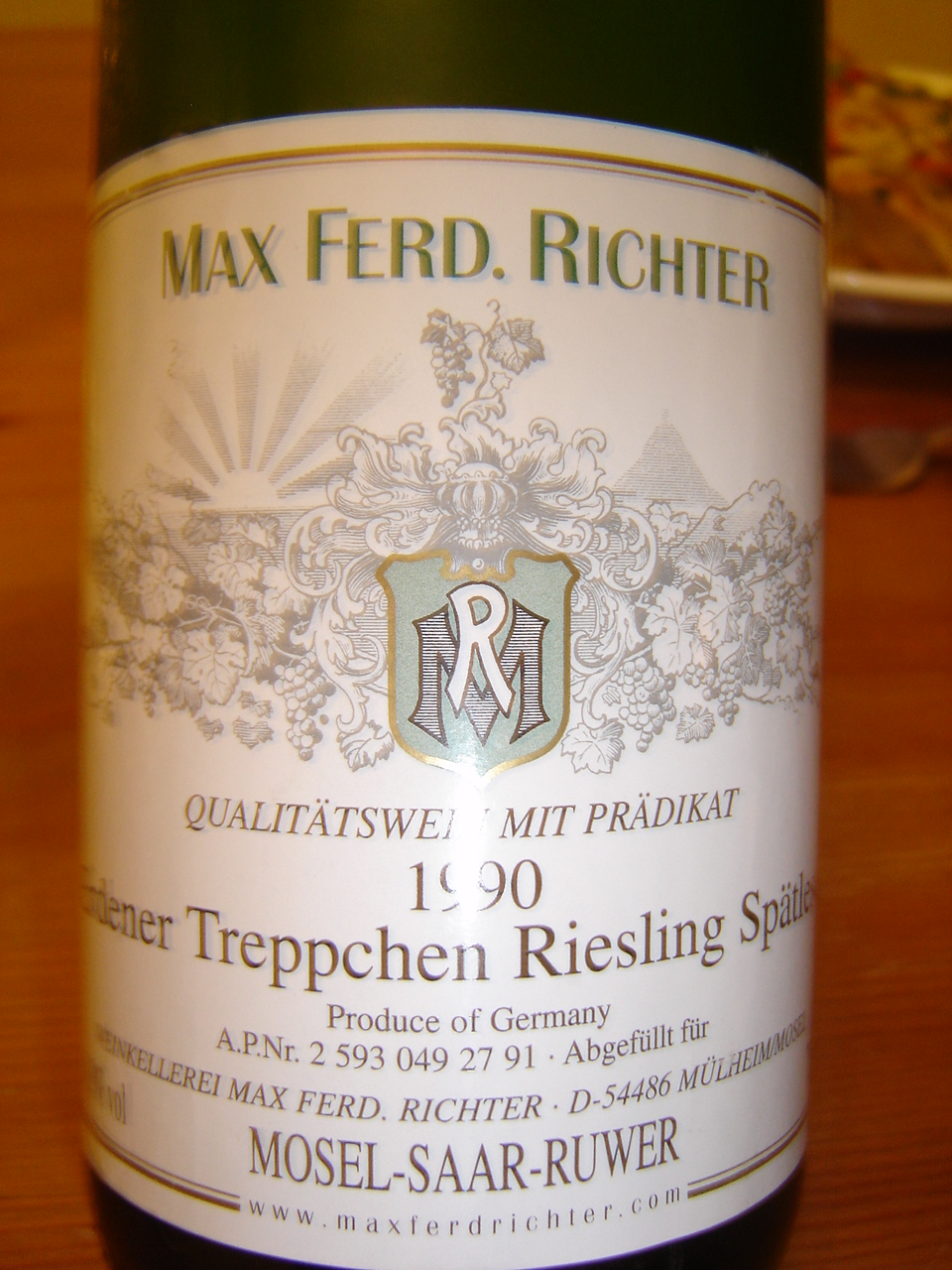
I had purchased a case of wine from the excellent MacArthur Beverages in Georgetown a few months ago, ostensibly for the purpose of hosting various wine tastings (including the Spanish tasting, the notes from which you can read here, and the outstanding Burgundy tasting, the write-up of which will be coming out later this week).  While there I came across this bottle:

It was the 1990 Weingut Max Ferd. Richter Erdener Treppchen Riesling Spätlese from the Mosel region of Germany (seen on the label as Mosel-Saar-Ruwer).

I was intrigued.  Law students don’t come across 19-year-old bottles of wine very often; one comes across old white wines even less frequently.  The price was right, too, at around $35-$40.  Phil, one of the wine stewards, saw that I was getting a few off-the-beaten-path-type wines like the 1999 Viña Gravonia Crianza and recommended the wine, saying that it was still very much alive and well though with some of the characteristic oxidation found in aged whites.  To seal the deal, the wine was apparently stored at the winery in perfect conditions until only a few months prior.  I couldn’t resist.

After the Burgundy tasting a few weeks ago, this was the last wine from my memorable trip to MacArthur Beverages.  But it was soon to join its noble brethren, as I had plans to open it for Alex’s celebratory meal.

For dinner, we invited the always engaging (and fellow Golden Bear) Waiching, who brought fresh blueberries and blackberries for dessert.  I can’t really describe what I cooked–it’s a recipe I made up some time ago and never bothered to write down.  I guess it could loosely be named lemon-mushroom chicken.  For my own purposes (I forgot what ingredients I needed while I was shopping for the meal at Trader Joe’s) I will list the recipe here:

Continue reading

Book Review: “Drink This: Wine Made Simple” by Dara Moskowitz Grumdahl

22 Nov

My roommate Alex just finished an ultramarathon–the JFK 50 Miler–yesterday, coming in 41st out of 1050 competitors.  (Congrats, Alex!)  Needless to say, he’s pretty intense when it comes to running.  He subscribes to running magazines, plots out his training schedule months in advance, and reads books upon books on marathoning.

I harbor no similar aspirations of athletic greatness, but I do read a lot on my own passion, wine.  The first book I read was Karen MacNeil’s excellent, excellent Wine Bible, which is a must if you’re at all interested in wine.  Other books I liked were Mark Oldman’s Oldman’s Guide to Outsmarting Wine, which is a very accessible primer with useful recommendations on everyday value wines, and the haughtily entertaining tome on French wines from the British wine writer Clive Coates, MW, An Encyclopedia of the Wines and Domaines of France, which though published in 2001 is still an exhaustive overview of literally every appellation of France.  (He writes like how I’d imagine General Cornwallis would have written had he been a wine critic in addition to being commander of the British troops in the Colonies.)

Continue reading

Guest Post: The Foodie Guide to Pairing Wine and Cheese

17 Nov

It’s the holiday season, which means there will probably be a lot of celebrating going on. If you’re having a party, you may be looking to pair wine and cheese, which is an often-daunting prospect. Thus, I’m delighted to have this guest post from Sara Kahn, Founder of The Cheese Ambassador.

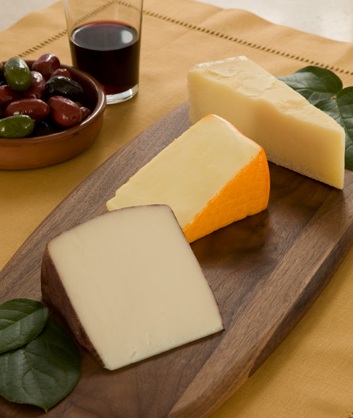
Whether you are hosting a soiree or a casual get-together this holiday, your mission is to provide your guests with warm hospitality, lively conversation and a delectable spread of food and drink. Whether the menu is complicated or simple it better be delicious. Serving a sumptuous gourmet cheese course is perfect as a starter or centerpiece of the meal. Not only is the preparation simple (no cooking!) but more importantly, your guests will enjoy discovering and savoring new favorites. As a wine lover, you want to impress with the right pairings but the overwhelming selections of wine and cheese can make your head spin. Relax. There are no hard and fast rules when it comes to choosing the right combinations of cheese and wine. Just keep in mind a few simple considerations.

A cheese course is about observing and enjoying contrasting and complementary flavors. For a foolproof gourmet cheese course, select 3 – 5 cheeses that vary in texture and flavor. Add some crusty bread, fresh or dried fruit, olives and nuts and voila!

Remember, wines are meant to cleanse the palate, wash away the tongue-coating richness of the cheese and prepare your mouth for the next delicious bite. It’s important that your selections don’t overwhelm the cheese and vice versa. Essentially, you’ll want to match wine and cheese of the same intensity level. Just remember “like for like”.

Take a look at the gourmet cheese categories and wine recommendations below for guidance. You’ll see how easy it is to serve an elegant wine and cheese course. For best results, just add friends and family.

Continue reading